
Hi gang,
This morning while waiting for the moka pot to finish my second cup of coffee, I got out my grandfather's fiddle, as I often do while the pot heats, and played a tune that I recently learned on the flute. Now, the fiddle is SO not my first instrument. It took me several times through before I was enjoying it at all. And that doesn't mean anyone else would be enjoying it even then. If you play music you know exactly what I mean.
Thinking about what was going on - my inability to play the notes I wanted - I noticed that playing a note on the fiddle is WAY easier than playing a note on the flute. The problem with the fiddle is ALL the notes are equally easy to play. The problem is not playing A note. It's playing THE note.
By contrast, once you can play notes on the flute, opening and closing a finger hole pretty much gets you into the ballpark. Not so with the fiddle. It will - and does - play any note within it's range quite happily, and your problem is not to play the right note, but to avoid playing the wrong notes.
Fast forward a few hours into my day. I may have just sat down with the third cup of coffee, I don't remember. But following a few clicks around the web looking for something else, I stumbled upon this talk from the 2011 TED conference. I've always enjoyed these talks and encourage you to randomly sample some others from their web site. There are MANY! But I digress...
This particular one is entertaining and pertinent to just about any human endeavor, including playing music. So many people fear playing in public, especially at the early stage of their music. Why? Fear of failure. Fear of being wrong. You know what? It's not that bad. Of course, if you suck, keep learning until you don't suck. But really sucking is way different from being able to play a tune perfectly at any speed. You don't need to be error-free to have fun playing in a session or for relatives. You just need to share what music you do have. The act of sharing can never be wrong.
Here's the video, enjoy! Carey
Friday, November 9, 2012

Monday, October 22, 2012
Care Of Parks Whistles
Hi,
I just got back from a week counting migrating raptors in the Florida Keys. They are mostly young birds who follow the coastline down and then jump across to Central and South America. For details visit
http://floridakeyshawkwatch.wordpress.com/
Upon return I found a question from a new customer in Germany. He was wondering how best to clean his Walkabout. Here's the meat of my reply. I thought others might have similar wonderments:
Best,
Carey
There are no wood parts. The fipple block feels like wood, but it's really sanding marks pretending to be grain.
You can clean it with water, soapy water, or put the parts in the top rack of the dishwasher (standing up is best.) Just be sure not to use a "heat dry" or any other setting that would get the temp near or over 100C. Too much of this might lighten the engraved markings, but won't hurt if you have a really big mess to clean up.
For stubborn beer residue or whatever, you can fold a strip of business card in half and when moist, run it into the windway. The only real sensitive part is the edge or labium. If you poke to strongly with something too stiff, like a wire pipe cleaner, you could damage it, and the sound will not be so clear.
Condensation is normal as the whistle warms up. I usually find I have to give it one blowing out about the third tune in the first set. I can do this while playing if the tune provides and opportunity to play a second octave A or B. Otherwise, put your finger over the window and give it a good blow. Once warm, there should not be much condensation.
If you want to minimize the problem, you can put a little soapy water in the windway, wipe off the outer parts and leave the soap in the windway to dry. This will help the water move out more easily and may just clear it during normal play.
The plastic doesn't mind being played hard and put away wet, but watch for growth inside if this is done a lot. A good way to kill bacteria is to dry them out.
I just got back from a week counting migrating raptors in the Florida Keys. They are mostly young birds who follow the coastline down and then jump across to Central and South America. For details visit
http://floridakeyshawkwatch.wordpress.com/
Upon return I found a question from a new customer in Germany. He was wondering how best to clean his Walkabout. Here's the meat of my reply. I thought others might have similar wonderments:
Best,
Carey
There are no wood parts. The fipple block feels like wood, but it's really sanding marks pretending to be grain.
You can clean it with water, soapy water, or put the parts in the top rack of the dishwasher (standing up is best.) Just be sure not to use a "heat dry" or any other setting that would get the temp near or over 100C. Too much of this might lighten the engraved markings, but won't hurt if you have a really big mess to clean up.
For stubborn beer residue or whatever, you can fold a strip of business card in half and when moist, run it into the windway. The only real sensitive part is the edge or labium. If you poke to strongly with something too stiff, like a wire pipe cleaner, you could damage it, and the sound will not be so clear.
Condensation is normal as the whistle warms up. I usually find I have to give it one blowing out about the third tune in the first set. I can do this while playing if the tune provides and opportunity to play a second octave A or B. Otherwise, put your finger over the window and give it a good blow. Once warm, there should not be much condensation.
If you want to minimize the problem, you can put a little soapy water in the windway, wipe off the outer parts and leave the soap in the windway to dry. This will help the water move out more easily and may just clear it during normal play.
The plastic doesn't mind being played hard and put away wet, but watch for growth inside if this is done a lot. A good way to kill bacteria is to dry them out.
Friday, October 12, 2012
Hello,
Quick post today, announcing "Wolfhound," a new Irish music band in southwest Florida.

Check out the sample tracks and let me know what you think. (That's me on the right end)
Slán,
Carey
Quick post today, announcing "Wolfhound," a new Irish music band in southwest Florida.

We are Wolfhound, South-West Florida's premier Irish Music Band! From the jigs and reels to the old ballads and the foot-stompin' drinking songs, we represent and celebrate the history of the Irish-American experience like no other!
Check out the sample tracks and let me know what you think. (That's me on the right end)
Slán,
Carey
Sunday, August 26, 2012
All Ready
The yard is clear and the house ready. It's looking like Isaac won't hit us too bad, but there are mandatory evacuations of some beach communities. Shelters are opening for these people this morning. Storm surge of 3 to 5 feet is predicted.
That doesn't sound like a lot, but the floor of our house is only 8.5 feet up.
One new thing the last couple years is some shelters are declared pet friendly so people with pets have a place to go.

Saturday, August 25, 2012
Lanai Getting Full
Photo of most of the stuff from the yard in the lanai. Still putting the tracks for the hurricane shutters in. I have to chase each hole with a tap and wire wheel the bolts the clean off the corrosion.

Interruption in Production for Isaac
Sorry those waiting for whistles will have their wait increased while we prepare the yard and house for a wind and storm surge event. (First post from my Android phone.)
Predicted path:

Predicted path:

Friday, August 17, 2012
Breanndán Ó Beaglaoich workshop and house concert

A couple days ago I held a house concert at Parks Whistles headquarters. Clearing the living and dining rooms of bulky furniture gave plenty of space and good acoustics for an afternoon workshop on West Kerry tunes and an evening concert by Breanndán Ó Beaglaoich, well known button accordion player from Boys of the Lough and Beginish.
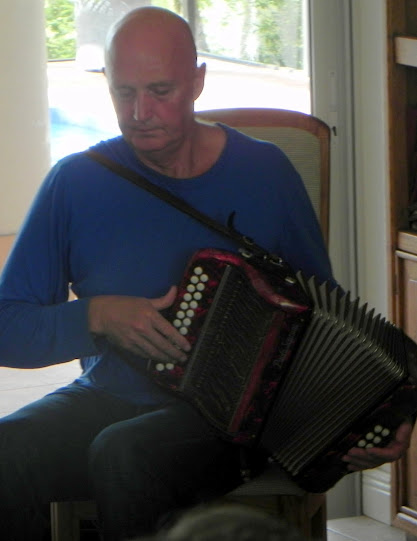
Breanndán Ó Beaglaoich working his magic.

Another generation takes up the bow.

Brendan and myself having a few tunes with coffee the following morning. What a pleasure to have so much music in the house for two days. If you are not familiar with Brendan and his music, that's easy to fix. There are several YouTube clips of him playing in various venues around the world, and his latest CD will give you a taste of the music he performed during the evening concert. (Available from http://www.brendanbegley.com/)
So now those who are waiting for me to ship their whistles know what has been holding me up. My apologies. It's back to the shop today!
Wednesday, July 11, 2012
Walkabout or Every?
Poor blog. If nothing is going on I don't post anything. If too much is going on, I don't post anything.
Here's a note I seem to be sending out a lot recently, so I thought I'd post it on the blog. Not that I don't want to hear from you, but to save you some time so you can write me with other questions.
Q: Is there any difference between your three-piece Walkabout and the two-piece Every models? I'm considering getting one of your whistles, but I'm not sure why I should prefer one over the other (except for the price difference).
A: They are made with the same tooling to identical specs save for the extra join between hands. If you have other whistles and carry a whistle roll or similar, you have no need for the Walkabout. But, if you want a whistle you can carry in your pocket, purse or backpack very easily, it's the Walkabout you want. I also find the Walkabout fits the pocket in my car's door much better than the Every Whistle.
Here's a note I seem to be sending out a lot recently, so I thought I'd post it on the blog. Not that I don't want to hear from you, but to save you some time so you can write me with other questions.
Q: Is there any difference between your three-piece Walkabout and the two-piece Every models? I'm considering getting one of your whistles, but I'm not sure why I should prefer one over the other (except for the price difference).
A: They are made with the same tooling to identical specs save for the extra join between hands. If you have other whistles and carry a whistle roll or similar, you have no need for the Walkabout. But, if you want a whistle you can carry in your pocket, purse or backpack very easily, it's the Walkabout you want. I also find the Walkabout fits the pocket in my car's door much better than the Every Whistle.
So, for playing they are the same, for carrying the Walkabout is to be preferred.
Hope that helps,
Carey
Friday, May 25, 2012
Visit To Baltimore
At the end of April I visited Baltimore. I had hoped to visit several sessions, but things conspired in a good way to keep me otherwise occupied. I have an aunt and three cousins in the Baltimore area and I wanted to visit them first of all. Originally thinking I'd go up in early May and catch the cherry blossoms and a session in DC too, that plan changed when another cousin in VA announced a wedding for the first weekend in May.
The net result being I only had a chance to stop in to J Patrick's on the Tuesday after the Baltimore Irish Arts Center held their Baltimore Irish Trad Fest 2012. Originally I was supposed to get in to BWI at 5 PM on Saturday and I thought maybe I could catch the Saturday evening concert and session at Liam Flynn's Ale House. But our plane was delayed 5 hours and I didn't get to BWI until nearly midnight. I think it was midnight by the time I cleared the airport in the rental car.
The net result being I only had a chance to stop in to J Patrick's on the Tuesday after the Baltimore Irish Arts Center held their Baltimore Irish Trad Fest 2012. Originally I was supposed to get in to BWI at 5 PM on Saturday and I thought maybe I could catch the Saturday evening concert and session at Liam Flynn's Ale House. But our plane was delayed 5 hours and I didn't get to BWI until nearly midnight. I think it was midnight by the time I cleared the airport in the rental car.
Anyway after all the excitement of the weekend, the Tuesday session was a small, quiet affair. Which I found quite enjoyable. It gave me a chance to play some flute with Dan Isaacson on uilleann pipes, Donna Long on fiddle and Patrick MacCubbin backing on DADGAD guitar and also giving us some tunes on his flute. The four of us sitting around one of the small drink tables had a nice session. As expected I did a fair amount of listening, but that's good. Why travel someplace else just to play the same tunes you always play at home? They were all great players and very nice people. If you are in Baltimore, try to make it to J Patrick's. I know I will be there again sometime. There are sessions on many if not most days of the week, so check the schedule.
From the chat I gathered the festival went quite well, and everyone was still enjoying the warm glow days later. Maybe it would be smart to be sure to catch the festival next time I'm up that way, provided of course there are no family weddings. (The wedding was great by the way, glad I could make it.)
Stay "tuned",
Carey
PS - If you have not clicked on the links above, do yourself a favor and browse around the sites. You'll be glad you did.
Thursday, April 19, 2012
Just Intonation and Equal Temperament Whistles
Again a customer has asked a question that I suspect others have had but have not asked me, so I will post below my response to the question "Are your whistles tuned to concert tuning?" Feel free to e-mail me or post a comment if you have questions or comments.
Slán,
Carey
Hi Jenny and Phil,
Slán,
Carey
Hi Jenny and Phil,
There are two aspects to the tuning of an instrument - the base note of a scale and the intervals within the scale played by the instrument.
On my non-tuneable Ghost whistle I am responsible for both. On my tuneable whistles, the player is responsible for the base note of the scale, and I am responsible for the intervals within the scale because I decide the position and size of the tone holes.
By default, my whistles are tuned in "Equal Temperament" (ET) which is the way modern orchestras, pianos and guitars are tuned. I'm assuming this is what you mean by "concert tuned." (I feel obligated to note that concerts are given on traditional instruments too!)
"Concert Pitch" will tell you what frequency a particular reference note should be tuned to. A=440 is normally used today, but the ensemble is free to agree on another pitch if they so choose, and everyone can accommodate it. Which is hard for things like accordions and pianos to do.
Once a reference pitch has been agreed, the next question is how are the intervals to be spaced? This is not very often thought about, since the maker of the instrument pretty much builds in the intervals. Fiddles and trombones have much more freedom to play what they will in terms of intervals. And harps and other instruments with individually tune-able strings at least have a chance, but it is a chore to re-tune for each key change.
Note that if A=440 is agreed, we can still have our C land in different places if we don't agree on the intervals we will use for our scale. So, all "concert" instruments today are tuned A=440 and Equal Temperament.
Just Intonation is the "natural" tuning of western instruments before the advent of "classical" music, and keyboard instruments. Simply put, you play a note, and then play a note one octave up, and it will be twice the frequency of the first. The other notes you play will fall on "nice" fractional intervals between the two.
The limitation (I didn't say "problem") of this approach is your playing is pretty much limited to one octave. When you play in the next octave, those perfectly places tone holes need to be in different places. So to allow compositions spanning more than one octave that were being penned by the "classical" composers, they had to agree to average out the location of the notes so they sounded equally good/bad regardless of which octave was being played.
I default my instruments to Equal Temperament because the first thing I expect customers to do is go find their piano or electronic guitar tuner and see how I did making the instrument.
I do offer D whistles in "Just Intonation" (JI) tuning, which I expect you are referring to when you say "trad tuning." These are most often purchased by pipers whose bagpipes are JI tuned, but solo players and people who play with baroque groups like them too.
Can you play a Just Intonation whistle along with a piano or guitar? Can you play an Equal Temperament whistle along with a baroque ensemble? The answer to both is a qualified yes, because player technique can push the notes for each hole around a bit. This is more easily done on a flute than on a whistle, but in each case you do have to actually PLAY the instrument vs. just blow and move your fingers.
An experienced musician, and I'm speaking more about their ear than their lips and fingers, will know if they are flat or sharp compared to the others they are playing with and can make some adjustments, within limits, to the tone they are playing.
Comparing one common interpretation of JI (which I use) to an ET C scale, here are the differences in cents for each note:
C -4
C# -12
D 0
D# 12
E 4
F 16
F# -14
G -2
G# -10
A 2
A# 14
B -15
So depending on the notes played and their duration, you may get by with an ET whistle in a baroque group. You will have to bend the note one way or the other 16 cents at most. That said, it is of course simpler to have the appropriate instrument to start with. But you still have to listen and play the right tone.
Question: What do you call three flutes playing A?
Answer: A chord.
Why do people bother with JI or "traditional tuning" any more? Because if you live within the limitation of one octave, the music sounds better. And with today's computer technology MIDI instruments can me controlled to play JI in any key with the push of a button. And, knowing the root note, I expect they can produce notes in multiple octaves that are nice round fractions of the root tone.
HERE is a link to a graphic demonstration of JI vs ET intervals. Sadly, this kind of on-the-fly re-tuning of the notes being played is not possible when playing a physical instrument. But you will see the reasons for each tuning I think. Please realize that when the narrator says "Clearly out of tune." he means clearly the intervals are not ideal for the selected root note of the scale. They ARE in perfect tune to the Equal Temerament tuning of the scale, which is what all of our keyboards, guitars, pianos, clarinets etc. come with these days so we can all play together in whatever key the composer (or singer) has selected for the performance.
Let me know if you'd like more info or if I've said something that isn't clear to you. Google will find more that you care to read if you search for "Just Intonation."
(Sadly the best site "justintonation.net" has been hacked and it's content replaced with some blather and I would expect the buttons to download a virus, so don't follow that link when it comes up in your search.)
Enjoy!
Carey
Subscribe to:
Posts (Atom)
